
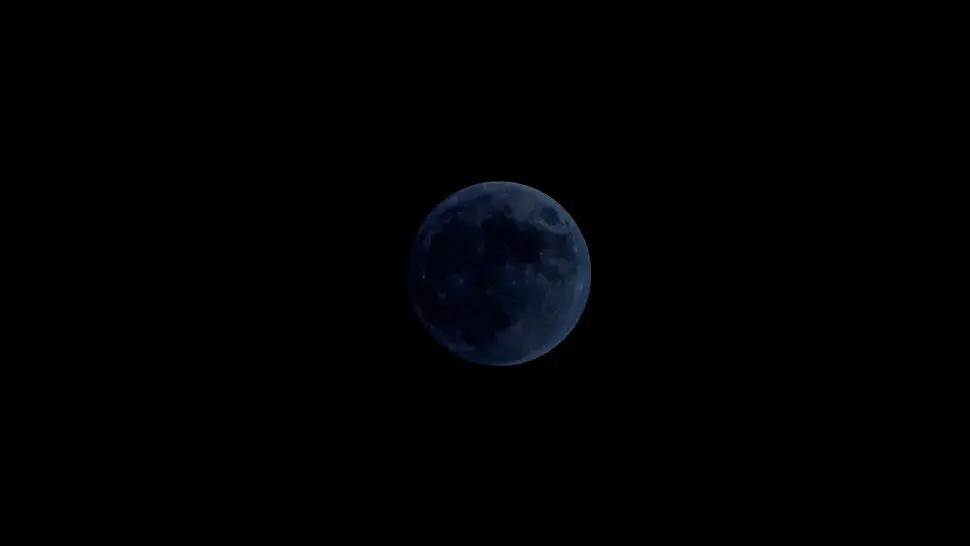
Though a new moon is not visible, the dark skies during a new moon provide ideal sky watching conditions. (Image credit: by-studio via Getty Images)
New moons occur approximately once every month because that's roughly how long it takes for the moon to orbit Earth. But because the moon's orbit is slightly tilted relative to Earth's orbit around the sun, it doesn't block out the sun on every orbit, hence why not every new moon results in a solar eclipse, according to NASA.
During this time, it appears as though you can see the entire disk of the moon dimly illuminated with an almost bluish-grey glow, along with the brightly lit crescent. As such, the term Earthshine is sometimes referred to as "The old moon in the new moon's arms." The glow is produced by light from a fully illuminated Earth reflecting off the lunar surface. Space.com's sky watching columnist Joe Rao explains the phenomenon in more detail in this interview conducted with FoxWeather.com.
- The second new moon in a single calendar month.
- The third new moon in a season of four new moons.
The next black moon will occur on Aug. 31, 2027, as per the first definition of the second new moon within a single calendar month.
When is the new moon? Calendar dates for 2026
This is when new moons will occur through 2026, according to NASA.
Date | U.S. Eastern time | U.K. time |
Jan. 18 | 2:52 p.m. (EST) | 7:52 p.m. (GMT) |
Feb. 17 | 7:01 a.m. (EST) | 1201 GMT |
March 18 | 9:23 p.m. (EDT) | 0223 GMT (March 19) |
April 17 | 7:52 a.m. (EDT) | 1252 BST |
May 16 | 4:01 p.m. (EDT) | 2101 BST |
June 14 | 10:54 p.m. (EDT) | 0354 BST (Jun. 15) |
July 14 | 5:43 a.m. (EDT) | 1043 BST |
Aug. 12 | 1:37 p.m. (EDT) | 1837 BST |
Sep. 10 | 11:27 p.m. (EDT) | 0427 BST (Sep. 11) |
Oct. 10 | 11:50 a.m. (EDT) | 1650 BST |
Nov. 9 | 2:02 a.m. (EST) | 0702 GMT |
Dec. 8 | 7:52 p.m. (EST) | 0052 GMT (Dec. 9) |
MOON PHASES
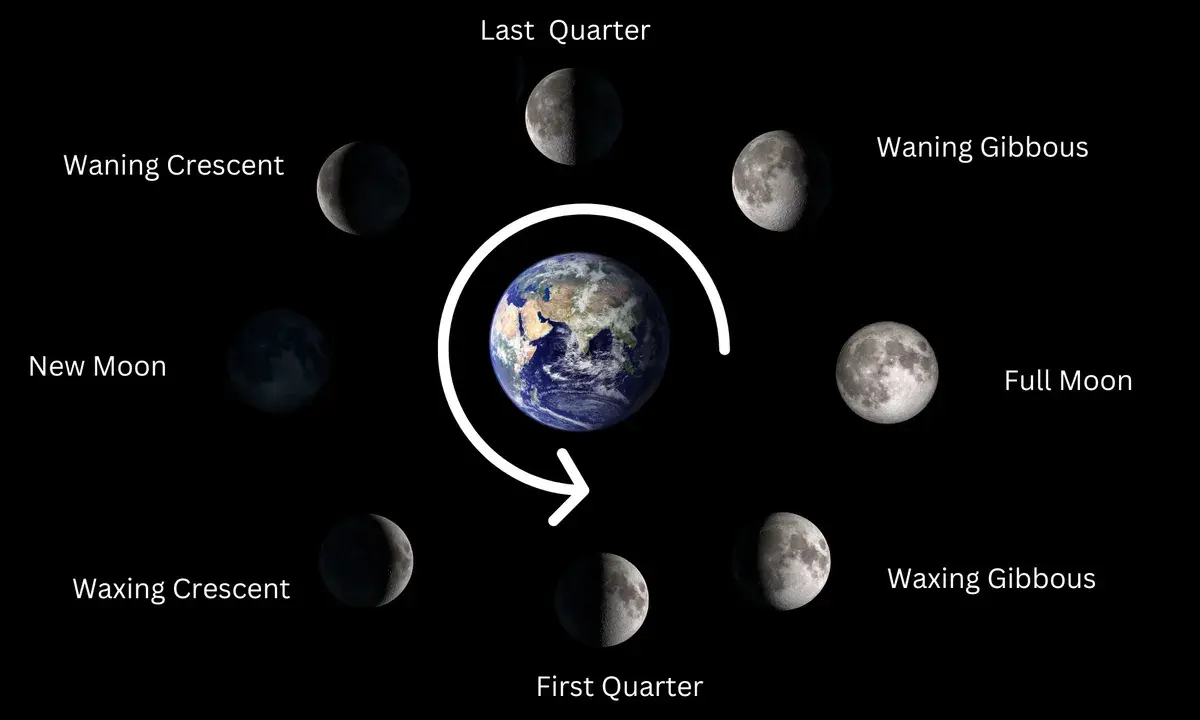 The moon's phases leading up to and away from the first quarter moon. (Image credit: NASA)
As the moon orbits Earth, it reflects sunlight and appears to cycle through eight distinct phases:
New moon: The moon is between Earth and the sun, and the side of the moon facing toward us receives no direct sunlight; it is lit only by dim sunlight reflected from Earth.
Waxing crescent: As the moon moves around Earth, the side we can see gradually becomes more illuminated by direct sunlight.
First quarter: The moon is 90 degrees away from the sun in the sky and is half-illuminated from our point of view. We call it "first quarter" because the moon has traveled about a quarter of the way around Earth since the new moon.
Waxing gibbous: The area of illumination continues to increase. More than half of the moon's face appears to be getting sunlight.
Full moon: The moon is 180 degrees away from the sun and is as close as it can be to being fully illuminated by the sun from our perspective. The sun, Earth and the moon are aligned, but because the moon’s orbit is not exactly in the same plane as Earth’s orbit around the sun, they rarely form a perfect line. When they do, we have a lunar eclipse as Earth's shadow crosses the moon's face.
Waning gibbous: More than half of the moon's face appears to be getting sunlight, but the amount is decreasing.
Last quarter: The moon has moved another quarter of the way around Earth, to the third quarter position. The sun's light is now shining on the other half of the visible face of the moon.
Waning crescent: Less than half of the moon's face appears to be getting sunlight, and the amount is decreasing.
Finally, the moon is back to its new moon starting position. Now, the moon is between Earth and the sun. Usually, the moon passes above or below the sun from our vantage point, but occasionally it passes right in front of the sun, and we get a solar eclipse.
What's the difference between a new moon and a full moon?
When the moon is at its new phase it is positioned between the sun and the Earth and appears in close proximity to where the sun is in our sky. So a new moon appears to rise and set with the sun and is invisible because sunlight is falling on that part of the moon that is turned away from us. We call it a "new" moon, because the cycle of phases that the moon displays to us takes 29.53 days to complete, and is known as a synodic month. The word synodic is derived from the Greek "sunodos" which literally means "meeting." And indeed, at roughly 29½-day intervals, the moon "meets" the sun and the cycle of lunar phases starts anew (hence we have a "new" moon).
In contrast, a full moon appears opposite to the sun in the sky. So it rises at sunset, appears highest in the middle of the night and sets at sunrise. The side of the moon that is turned toward Earth is fully illuminated, hence the term "full" moon.
How long does a new moon last?
Astronomers calculate the moment of a new moon based on its position in the sky relative to the sun. When both the sun and the moon have the same right ascension (the distance of a point east of the vernal equinox, measured along the celestial equator and expressed in hours, minutes, and seconds) that is the time of a new moon. Since the moon is constantly moving in its orbit around the Earth, a new moon only lasts for a moment. However, to be able to see the moon is another matter; we usually must wait at least 18-24 hours after the new moon to allow it to move far enough away from the sun. We then see it low in the western sky appearing as a lovely crescent phase and setting an hour or two after sunset.
There is another way to see a new moon: When it passes directly in front of the sun to produce a solar eclipse. Then, the dark disk of the new moon — normally unseen every month — is visible in silhouette, passing across the face of the sun.
The man who was known as "the world's greatest nonprofessional astronomer," Leslie C. Peltier (1900-1980), once noted that "Only during an eclipse of the sun can we note the instant when the old moon, moving eastward, crosses the median line of the sun and becomes a fresh new moon just starting out on another monthly lifetime."
How often do we experience a new moon?
Usually once a month, although if a new moon happens on the first or second day of the month, a second new moon is likely to occur at the end of the month. Only in the month of February is it possible not to have a new moon. This can happen because even in years where there is a leap day, February can have no more than 29 days. But because a synodic month lasts about 29.5 days, we can have a new moon on January 30 or 31, but the very next new moon would not occur until March 1; completely bypassing February! Such an odd circumstance will happen in the year 2033.
Bibliography
When Is the Next Black Moon? Time and Date, https://www.timeanddate.com/astronomy/moon/black-moon.html
When and where to spot the 'Di Vinci Glow', Fox Weather,
https://www.foxweather.com/watch/play-6669f25650000cb
Lunar Phases, NASA,
https://solarsystem.nasa.gov/moons/earths-moon/lunar-phases-and-eclipses/#otp_what_are_lunar_phases?
Find out more from https://www.space.com/17561-new-moon-explained-lunar-phases.html